A Lacey Act declaration may be required when a formal U.S. entry contains plant material and the finished product’s HTS code appears on APHIS’ implementation schedule. For furniture and wood products, the importer should confirm scope first, then collect scientific name, country of harvest, plant quantity, value and supply-chain data before the broker files the entry.
This 23-point guide is for furniture buyers, wood-product importers, customs teams and DDP coordinators. It organizes the data needed for accurate filing; it does not classify a particular product, determine legality of harvest, or replace the current APHIS schedule, CBP entry rules or qualified customs advice.
Four questions determine whether to prepare a declaration
APHIS’ current Lacey Act declaration requirements state that a declaration is required when the product contains plant material, is classified under a listed HTS code, is imported as a formal entry and uses a covered entry type. The finished product’s classification and entry type matter; do not decide scope from the product description alone.
Lacey declaration and ISPM 15 are separate controls
A Lacey declaration concerns plant and plant-product information for covered imports. ISPM 15 concerns treatment and marking of regulated solid-wood packaging material. A furniture shipment can require both, one or neither depending on the product, packaging and entry. Use DDPexpert’s ISPM 15 wood-packaging checklist for pallets and crates, but do not use an ISPM 15 mark as evidence of the furniture’s species or harvest country.
The 23-point Lacey Act filing checklist
A. Confirm scope and filing responsibility
- Freeze the finished product and SKU. Record model, construction, plant-based components, quantity, value and planned entry.
- Confirm the 10-digit HTS classification. Keep the classification rationale and review it against the current APHIS implementation schedule.
- Confirm formal or informal entry status. Ask the broker which CBP entry type will be used and document the basis.
- Identify the importer of record. Only the importer of record or an authorized agent may file; confirm the party before shipping. See the DDP importer-of-record guide.
- Authorize the filer. If a customs broker files, ensure the importer has provided the required power of attorney and approved the source data.
B. Build a plant-material bill of materials
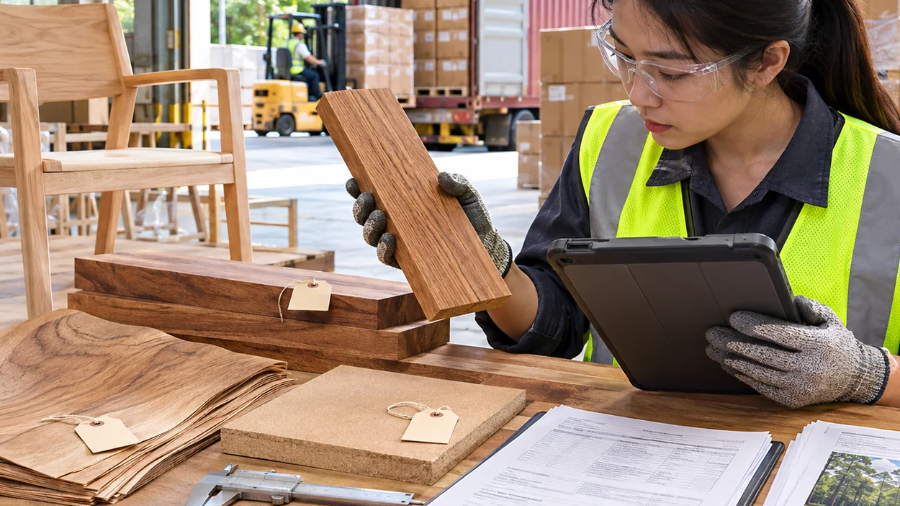
- List every plant-based component. Include solid wood, veneer, plywood, MDF, HDF, particleboard, OSB, cork, paper and other plant-derived material.
- Separate product material from packaging. Identify packaging used only to support, protect or carry another item, and document when packaging itself is the imported merchandise.
- Record component weight or volume. Use the metric unit required for the declaration and retain the calculation method.
- Map component to supplier and factory. A finished chair may combine frame wood, veneer, seat board and paper packaging from different sources.
- Control substitutions. Require written approval before a factory changes species, veneer, board core, supplier or country of harvest.
C. Collect species and harvest-country evidence
- Request scientific names. Collect genus and species, not only commercial names such as “oak,” “rubberwood” or “mixed hardwood.”
- Record country of harvest. This is where the plant was taken, not automatically the country where furniture was assembled or exported.
- Connect the data to the shipped lot. Purchase orders, mill invoices, batch records and delivery notes should connect plant material to production.
- Verify uncertain species or countries. APHIS says that when exact species or harvest country cannot be determined, filers may need to report each species or country that may have been used.
- Use special use designations correctly. APHIS provides SUDs for certain composite, recycled, reused, reclaimed or pre-amendment materials when the specific conditions apply.
- Check protected species separately. CITES, endangered-species or other restrictions can apply even when a declaration exception would otherwise be considered.
D. Prepare entry and declaration data
- Reconcile product description and value. The declaration, commercial invoice and entry should describe the same goods and value. Use the DDP commercial invoice checklist before pickup.
- Confirm required shipment identifiers. Prepare importer and consignee details, HTS code, bill of lading, container number and manufacturer identification code where applicable.
- Calculate plant quantity consistently. Retain worksheets that show how component quantities roll up to the declared metric quantity.
- Select ACE or LAWGS intentionally. APHIS describes ACE as the primary filing method and LAWGS as an option for specified circumstances, including foreign-trade-zone filings.
- Use a disclaimer only with documented facts. A disclaimer explains why the flagged tariff line does not require declaration data; it is different from an SUD used within a declaration.
E. Verify and retain the shipment record
- Review the filed data before arrival. Compare the broker’s transmission or filing confirmation with the approved worksheet and correct errors promptly.
- Preserve the evidence set. Retain the BOM, species and harvest-country records, quantity calculation, invoices, transport documents, filing confirmation, approvals and any correction trail.
Declaration data worksheet
Disclaimer code and special use designation are not interchangeable
APHIS’ Lacey Act FAQ distinguishes the two. A disclaimer code is used when a tariff line triggers the Lacey message set but declaration data is not required under the applicable facts. An SUD supplies an allowed description in the genus/species field for certain materials when a declaration is required. Record the reason and evidence; do not select either code simply because the supplier cannot provide data.
Composite furniture needs an intentional review
MDF, HDF, particleboard, paper and other re-composed plant materials can fall within declaration requirements when the finished product is listed and no exception applies. APHIS guidance allows specified special use designations in appropriate cases, but the importer still needs all other required information. Ask the factory for the board type, weight, source, recycled content where relevant and the upstream supplier record.
Pre-shipment verification at the factory
During final inspection, compare the approved BOM with the production unit, packaging label, carton model and purchase order. Photograph visible grain, veneer, board edges, component marks, carton labels and loading sequence. DDPexpert’s container-loading inspection checklist can help connect the inspected lot to the sealed shipment, but photographs do not replace species and harvest-country records.
Frequently asked questions
Does every wooden product require a Lacey declaration?
No. Scope depends on plant material, the finished product’s listed HTS code, entry type and applicable exceptions. Check the current APHIS schedule and the actual entry facts.
Is the country of manufacture the same as country of harvest?
Not necessarily. Furniture may be manufactured in one country from timber harvested in another. The declaration asks for where the plant was taken.
Can the broker determine the wood species for the importer?
The broker can transmit supplied data and advise on filing, but the importer and its agent assume responsibility for accuracy. Collect species and source information from the supply chain before shipment.
Shipment release decision
Release the shipment only after the finished product and HTS code are confirmed, declaration scope is documented, every plant component is mapped, scientific names and harvest countries are supported, quantities and values reconcile, the importer and filer are authorized, and the final filing data matches the entry. If the factory cannot identify the plant material or a disclaimer lacks a factual basis, pause the shipment and resolve the evidence gap.
 English
 Deutsch
 Português
 العربية
 中文

 07 Nov