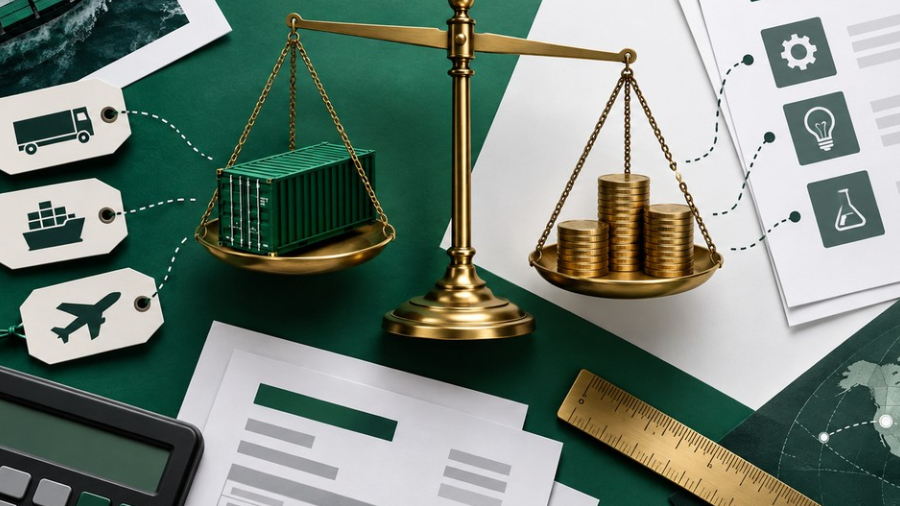
DDP (Delivered Duty Paid) and FOB (Free On Board) are two widely used Incoterms that define how costs, risks, and responsibilities are divided between buyer and seller in international trade. Under DDP, the seller assumes maximum responsibility, including import duties and customs clearance. Under FOB, the seller’s responsibility ends once goods are loaded onto the vessel at the origin port.
When businesses compare DDP vs FOB, they are not simply comparing freight options. They are deciding how risk, cash flow, compliance exposure, and cost control will be structured across the supply chain.
Understanding the difference between DDP and FOB allows importers to align logistics execution with financial strategy.
This guide provides a full structural analysis to help businesses determine which Incoterm truly saves more money.
1. Understanding the Core Structure of DDP and FOB
Before comparing cost, we must clearly define responsibility boundaries.
1.1 What Is DDP (Delivered Duty Paid)?
Under DDP Incoterms 2020, the seller is responsible for:
- Export customs clearance
- Main international freight
- Insurance (if agreed)
- Destination port handling
- Import customs clearance
- Import duties and VAT
- Final delivery to named location
Risk transfers only when goods are ready for unloading at destination.
DDP represents the highest level of seller obligation.
1.2 What Is FOB (Free On Board)?
Under FOB shipping terms, the seller must:
- Clear goods for export
- Deliver goods to the origin port
- Load goods onto the vessel
Once the goods are on board, risk transfers to the buyer.
The buyer then assumes responsibility for:
- Main freight
- Insurance
- Destination charges
- Import clearance
- Duties and taxes
- Final delivery
FOB is traditionally used for sea freight.
2. Responsibility Matrix: DDP vs FOB
Below is a simplified operational comparison.
Responsibility | DDP | FOB
Export clearance | Seller | Seller
Origin port charges | Seller | Seller
Loading onto vessel | Seller | Seller
Main freight | Seller | Buyer
Insurance | Seller (if agreed) | Buyer
Destination port fees | Seller | Buyer
Import clearance | Seller | Buyer
Import duties | Seller | Buyer
Final delivery | Seller | Buyer
Risk transfer point | At destination | At origin port
This matrix reveals that DDP centralizes responsibility, while FOB distributes responsibility.
3. Cost Structure Comparison
The real question in DDP vs FOB is not which is cheaper, but which cost structure aligns with your operational capability.
3.1 Freight Pricing
Under FOB, buyers can negotiate freight directly with carriers.
Under DDP, freight is embedded within the seller’s quote.
If the seller has strong logistics partnerships, DDP freight may be competitive.
If the buyer imports frequently, FOB may offer better freight leverage.
3.2 Import Duties & Taxes
Under DDP:
Seller pays and includes in pricing.
Under FOB:
Buyer pays directly upon arrival.
For large shipments, duty payment timing can impact working capital.
3.3 Hidden Charges
FOB exposes buyers to:
- Terminal handling charges
- Documentation fees
- Storage/demurrage
- Inspection fees
DDP consolidates these into one bundled price.
Predictability vs transparency is the core trade-off.
4. Risk Allocation Model
Risk is often underestimated when comparing DDP and FOB.
4.1 Transit Risk
Under FOB:
Risk transfers once goods are on board vessel.
If damage occurs during ocean freight, buyer must claim insurance.
Under DDP:
Seller bears transit risk until destination.
4.2 Customs Risk
Under FOB:
Buyer handles customs compliance.
Under DDP:
Seller assumes import compliance responsibility.
In regulated industries, customs risk exposure can be significant.
5. Cash Flow & Working Capital Impact
Cash flow considerations can influence Incoterm selection.
Under FOB:
- Buyer pays freight and duties separately
- Duties may be paid upon arrival
- Allows better control of timing
Under DDP:
- Duties are prepaid within invoice
- Total landed cost known upfront
- Less flexibility in payment structuring
High-volume importers often prefer FOB for cash flow optimization.
6. Numerical Scenario Analysis
Let’s evaluate a $100,000 shipment with 10% duty.
Scenario A: DDP
Duty = $10,000
Seller adds 4% risk margin = $4,000
Total = $114,000
Predictable, simplified.
Scenario B: FOB
Freight = $6,000
Insurance = $800
Duty = $10,000
Destination charges = $2,500
Total ≈ $119,300
However, if freight is negotiated at $4,500 and brokerage optimized:
Total ≈ $117,000
Savings depend on buyer capability.
7. When DDP Saves More Money
DDP may be advantageous when:
- Importing into complex regulatory markets
- Limited customs expertise
- First-time imports
- Low shipment frequency
- Risk avoidance is priority
DDP reduces operational uncertainty.
8. When FOB Saves More Money
FOB may be financially advantageous when:
- High shipment frequency
- Strong freight contracts in place
- Established customs brokerage network
- High-volume import scale
- Margin optimization strategy
FOB provides long-term cost control.
9. Strategic Decision Framework
Ask the following:
Do we control freight contracts?
Do we understand destination customs rules?
Is cost predictability critical?
Are we importing frequently?
Is risk transfer timing important to us?
If operational maturity is high → FOB often makes sense.
If risk tolerance is low → DDP reduces complexity.
10. Industry-Specific Use Cases
10.1 E-Commerce
DDP simplifies customer experience.
10.2 Manufacturing Imports
FOB often used to integrate with existing logistics systems.
10.3 New Market Entry
DDP reduces compliance learning curve.
11. Long-Term Strategy
Many businesses start with DDP when entering a new market.
After building customs knowledge, they transition toward FOB.
This progression reflects operational development.
12. Common Misconceptions
Myth: DDP is always more expensive.
Reality: It may reduce hidden operational cost.
Myth: FOB is always cheaper.
Reality: Only if managed efficiently.
Myth: Risk ends at port under FOB without consequence.
Reality: Insurance and freight liability become buyer responsibility.
13. Final Strategic Summary
DDP vs FOB is not a simple pricing comparison.
It is a structural financial and operational decision.
DDP centralizes responsibility and simplifies procurement.
FOB distributes responsibility and may improve long-term cost efficiency.
The correct Incoterm depends on:
- Experience level
- Volume
- Cash flow priorities
- Risk tolerance
- Compliance capability
Choosing the right term aligns logistics structure with business strategy.
 English
 Deutsch
 Português
 العربية
 中文
中文


 25 Sep